

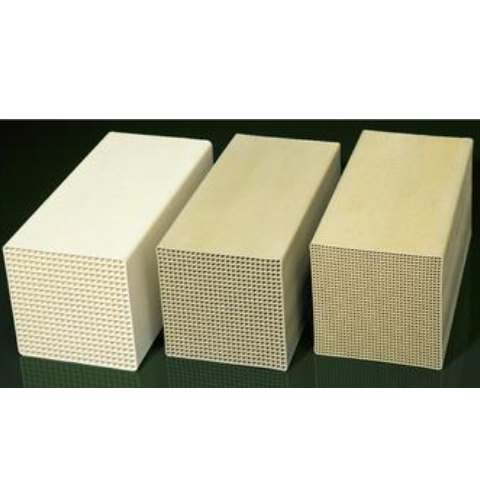
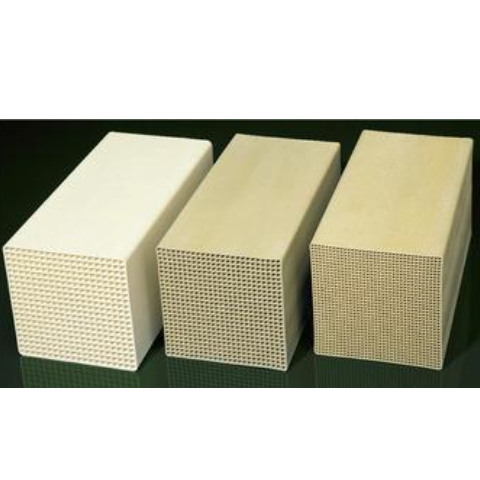
KC-202 is a SCR denitrification catalyst of flue gas using honeycomb ceramics as its carrier, suitable for various processes where emissions of nitrogen oxides is required to be reduced in the chemical, refining, steel and auto industries. KC-202 selectively removes NOx from flue gases under aerobic condition using ammonia as the reductant, with the NOx removal rate of over 90%. The KC-202 catalyst is featured for its high denitrification efficiency, low ammonia consumption, wide operating temperature range, low SO2 conversion and long working life.
KC-202 is prepared by adding additives, active components to the titanium base carrier and then being integrally shaped. The KC-202 catalyst has the following advantages: high specific surface area, great active stability, high primary denitrification efficiency, low ammonia escape rate (<3ppm) and no secondary pollutions. KC-202 also has a superior abrasion resistance and an excellent regenerative activity.
Technical Features:
|
Configuration |
Honeycomb |
|
Operating
Temperature (℃) |
170 – 450 |
|
NOx
Content at the Exit (mg/Nm3) |
≤100 |
|
NH3
Content at the Exit (ppm) |
≤3 |
|
Conversion
of SO2 to SO3 |
≤1% |
|
Pressure
Drop (kPa) |
≤1.4 |
Ammonia can be provided in the solution or in the form of liquid ammonia, depending on the circumstances.
Catalytic Reactions:
4NO + 4NH3 + O2 ----- 4N2 + 6H2O
2NO2 + 4NH3 +O2 ----- 3N2 + 6H2O
Direction for Use:
The liquid
ammonia stored in the tank is initially vaporized and sent to the SCR system
with the flue gas. After the knockout drum, the stabilized ammonia gas is then
mixed with diluted air in the mixer and then sprayed into flue gas in the
upstream of the SCR reactor. The reduction reaction converting NOx
to N2 takes place in the SCR reactor in the presence of KC-202
catalyst.