

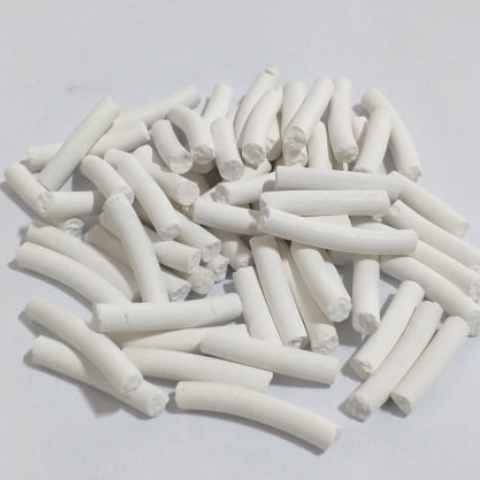
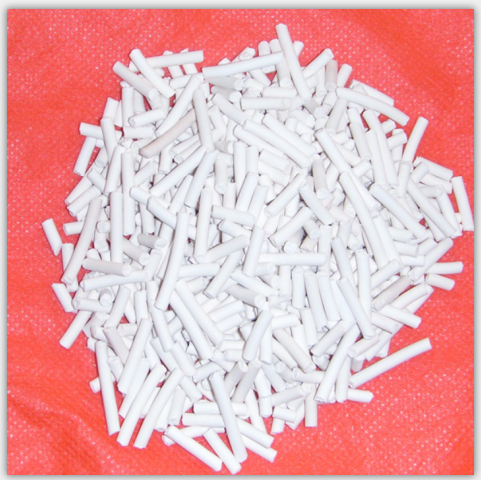
KC-404 is a TiO2-based sulfur recovery catalyst. Compared to the Al2O3-based catalyst, KC-404 has the following advantages:
1) KC-404 is more catalytic active in the organic sulfide hydrolysis reaction and Claus reaction, increasing the overall sulfur conversion by 1.5 - 2.0% under the same operating conditions almost to the thermodynamic equilibrium.
2) KC-404 has the anti-sulfating effect and insensitive to the escaped O2. Up to 10,000ppm of O2, the catalytic activity is reversible once the O2 concentration reduces.
3) Higher airspeed (1000 – 12000 h-1) is allowed in order to reduce the reactor volume but reaching the same conversion. KC-404 is especially suitable for the conditions where the H2S content or flowrate is changeable.
Technical Features:
- High mechanical strength and strength stability.
- High catalytic activity and deoxygenating ability.
- Excellent selectivity and active stability.
- High operating flexibility, with the adaptive capacity for high airspeed.
- Long working life.
Physical and Chemical Properties:
|
Colour |
White |
|
Configuration |
Five-leave
clover or Strip type |
|
Basis |
Al2O3 |
|
Specific
Surface Area (m2/g) |
≥100 |
|
Bulk
Density (kg/m3) |
700
– 820 |
|
Crushing
Strength (N/cm) |
≥130
(avg) |
|
Wear
Rate% (m/m) |
≤0.5 |
Direction for Use:
KC-404 catalyst can be used by layers with Al2O3-based catalysts, loaded into the packed bed of any Claus reactors for sulfur recovery unit. KC-404 should be installed on the upper part of the bed, accounting for over 1/3 of the total bed volume, in order to protect the Al2O3-based catalysts below from being oxidized by the escaped O2 from upstream of the process. A few rules should be followed during the operation:
1) The optimum H2S/SO2 ratio should be controlled to be 2:1; this is the key to achieve the highest sulfur recovery rate.
2) The temperature of any point of the entire bed cannot be lower than the dew point of sulfur. Therefore, the minimum operating temperature required for the first reactor is 220℃ and 210℃ for the second reactor.
3)
The maximum
operating temperature of the entire bed is 450℃